
ArticleEngineering & construction
Why Young Engineers Should Not Be Leading Forensic Investigations
Forensic engineering is reverse engineering - and it is not an entry-level profession.
Forensic engineering is where everything an engineer has learnt about design, construction and project delivery is tested against a building that did not behave as intended.
Let Me Say What Many Consultancies Will Not
Let me say something that many engineering consultancies may not want to hear: forensic engineering is not an entry-level profession.
Young engineers should absolutely be exposed to forensic work. They should inspect buildings, take measurements, map defects, review drawings, coordinate testing, build analytical models and prepare preliminary findings under proper supervision. That is how the next generation learns.
But they should NOT ordinarily be left to independently diagnose complex building failures, issue broad safety conclusions or determine major remedial strategies before they have learnt how buildings are designed, constructed and delivered.
This is not an attack on youth, nor is it an argument that age automatically produces competence. A 30-year-old engineer with intensive design and site responsibility may be better prepared than a 50-year-old who has spent a career repeating narrow calculations. The issue is accumulated engineering experience - and whether the investigator has ever carried real responsibility for the systems now being assessed.
A person can be registered as an engineer and still be unready to diagnose why a building failed.
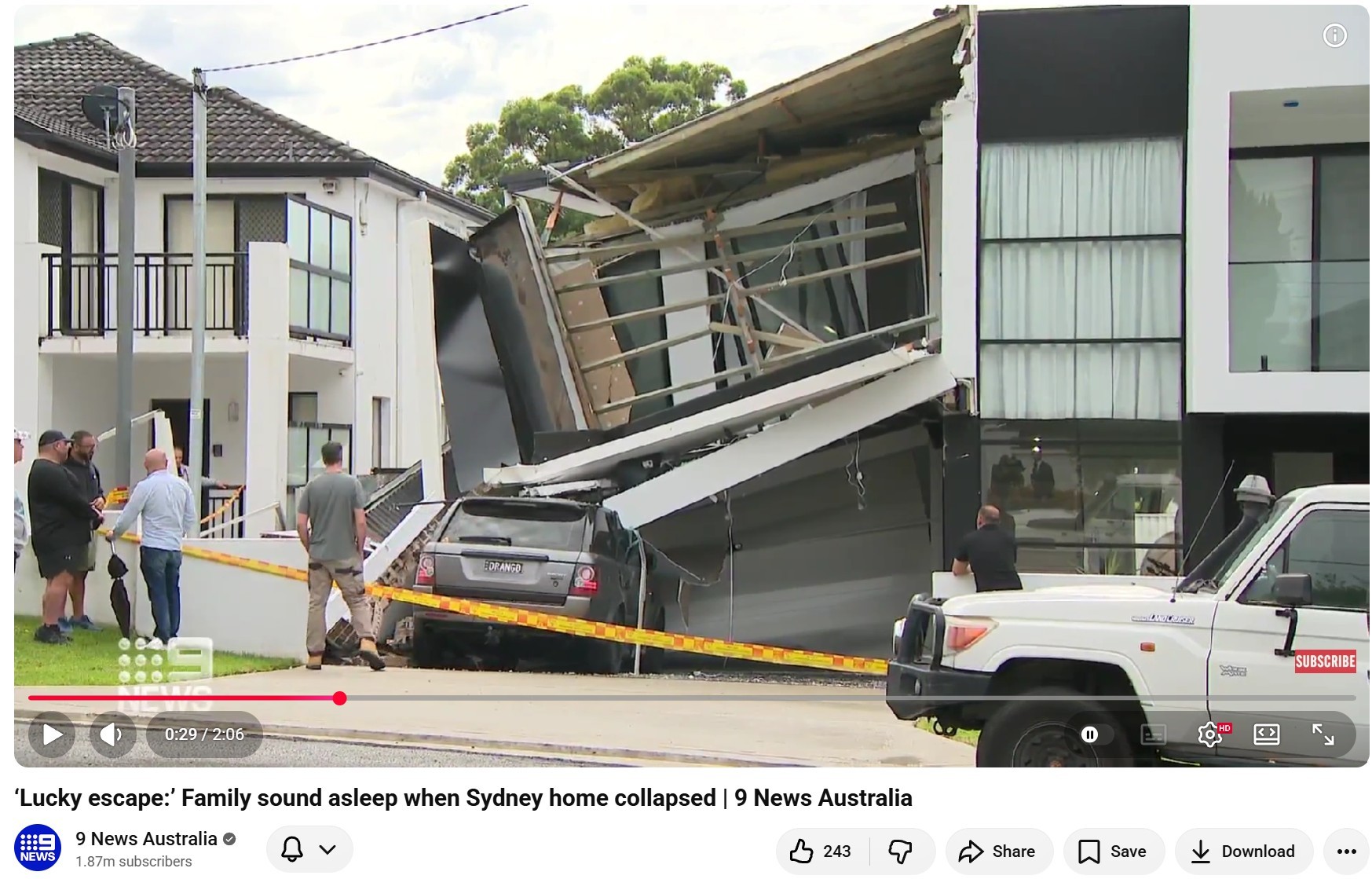
Australia does not have a shortage of defect reports. Some run to hundreds of pages and contain photographs, crack widths, moisture readings, references to standards and long schedules of repairs. Yet owners can spend hundreds of thousands - sometimes millions - implementing those recommendations, only to find that the cracking returns, the water reappears or the repaired building develops a different problem.
Too much of what is described as forensic engineering is really defect recording. The investigator may be able to photograph a symptom, measure it and quote a provision, but may never have designed that system, administered its construction or understood how all its parts were intended to work together.

What Building Assessment Actually Involves
Before discussing who should lead this work, it is worth clarifying what building assessment actually involves. The terminology is often used loosely, but inspection, testing, assessment, diagnosis and remedial design are not interchangeable.
I often compare the process with medical care. Defects are symptoms. Inspection is the consultation and physical examination. Testing is the blood work, CT scan or biopsy. Engineering assessment is the diagnosis. Remedial design is the treatment plan. Construction is the treatment itself, while verification and monitoring are the follow-up.
Different assignments also ask different questions. A condition assessment records the present state of a building. A safety or structural-adequacy assessment considers whether it can continue to perform its intended function. A damage or failure investigation seeks causation. Other assessments may support a proposed alteration, change of use, strengthening scheme, insurance claim or legal proceeding. Waterproofing, façades, hydraulic services, fire safety and other building systems may require their own targeted investigations. The purpose of the assessment determines the evidence, depth and expertise required.
Document review.
The process commonly begins with the brief and available records: approved and as-built drawings, specifications, calculations, construction records, previous reports, maintenance history, photographs and earlier repairs. A desktop review establishes what is known, what conflicts and what must be verified on site.
Inspection.
Inspection establishes what can be observed and where it occurs. It may include visual examination, defect mapping, crack-width measurement, dimensional or level surveys, moisture readings, thermal imaging, drone surveys, borescopes or CCTV. Its value lies not merely in collecting photographs, but in documenting the distribution, pattern, timing and apparent relationship between symptoms.
Testing and intrusive investigation.
Where observation is insufficient, further evidence may come from non-destructive testing such as GPR, cover meters, UPV or rebound testing; invasive opening-up to expose concealed construction; destructive sampling such as concrete cores or steel coupons; laboratory testing for strength, composition, chlorides, carbonation or petrography; and monitoring using crack gauges, level surveys, inclinometers, piezometers or moisture loggers. Invasive and destructive are not synonymous: an opening-up may be local and repairable, whereas destructive testing normally consumes or permanently alters a sample.
Engineering assessment and diagnosis.
This is where evidence becomes engineering judgement. The assessor may undertake load-path review, desktop calculations, FEA or other numerical modelling, soil-structure interaction analysis, durability assessment, causation analysis, testing of competing hypotheses, and evaluation of safety, serviceability, remaining life and consequence. Testing produces data; it does not diagnose the building. The assessment must explain why the observed pattern occurred, what it means and how confidently the evidence supports that conclusion.
Remedial strategy, design and verification.
A diagnosis then informs the remedial roadmap: source control, repair, strengthening, replacement, temporary measures or monitoring. Remedial design converts that strategy into calculations, details, specifications, construction sequencing, quality controls, hold points and acceptance criteria. Procurement, construction, verification and post-remediation monitoring complete the process.
Inspection finds the symptoms. Testing supplies evidence. Assessment requires judgement. Remedial design turns that judgement into a buildable solution.
This sequence is not always linear. Assessment may reveal that more testing is needed; opening-up during construction may challenge the original hypothesis; monitoring may require the diagnosis or design to be revisited. Leading the work therefore means controlling an iterative reasoning process, not simply completing a checklist.
Why Experienced Inspectors Often Outperform Young Engineers
When I first established my own business in Australia, pre-purchase inspections were one of my principal sources of income. I came to see the role as broadly comparable to that of a general practitioner. A pre-purchase inspection is a preliminary whole-building assessment: the inspector identifies visible defects, forms an initial opinion on their likely causes and significance, recommends an indicative remedial direction, and refers the purchaser to an appropriate specialist where necessary.
That referral is not a failure. It is responsible professional practice. A good building GP must know both what can be judged from a general inspection and when the problem requires a specialist.
Some of the most capable pre-purchase inspectors I have met do not hold engineering degrees. Yet after inspecting hundreds or thousands of buildings, and repeatedly seeing how particular defects develop, their practical judgement can be vastly more accurate than that of a young engineer who may have the degree, the registration and the software, but very little real-world exposure.
Qualifications provide knowledge. Repeated exposure converts that knowledge into pattern recognition and judgement.
My own advantage did not come from structural engineering alone. Years of design, construction and project-management experience allowed me to examine a building from a whole-of-project perspective: from the original design assumptions and load paths, through construction sequence, workmanship and trade interfaces, to later operation, maintenance and alteration.
That broader view became particularly valuable in difficult or unusual cases. It allowed me to connect symptoms that initially appeared unrelated, reconstruct how the problem had developed and pinpoint the root cause, rather than merely treating the most visible defect. When the available evidence remained incomplete, I could define the specific investigation required instead of making a generic referral for “further assessment”.
Forensic Engineering Runs the Project Backwards
The essential nature of forensic engineering is reverse engineering.
Forward engineering starts with an intended outcome. The engineer develops the analysis, design, details and documentation; the project then moves through procurement, construction, commissioning and operation. Forensic engineering begins at the opposite end. Something has cracked, moved, leaked, corroded, malfunctioned or collapsed. The investigator must work backwards through the physical mechanism, construction history, design assumptions and original intent.
That is why a forensic engineer must first understand forward engineering. If you do not know how a building should have been designed, coordinated and built, how can you reliably explain why it failed?
This is where the whole-of-project perspective becomes decisive. Design reveals intended behaviour; construction explains what may actually have been built; project delivery exposes the effect of sequencing, coordination, temporary conditions, procurement and change. Causation is often found at the interface between those stages, not within any one of them.
A design-only engineer may understand how a building should work. A construction-only practitioner may recognise poor workmanship. A forensic engineer must connect both.
This matters because failures rarely respect professional boundaries. A crack that looks structural may originate in ground movement, drainage, thermal effects or construction sequence. A “waterproofing failure” may begin with levels, geometry, movement or a services penetration. A services malfunction may be inseparable from the structure or the building envelope. The investigator must cross those interfaces without pretending to possess expertise that properly belongs to another specialist.
Australia Regulates New Buildings Better Than Failed Ones
Australia regulates the creation of a new building in considerable detail. The NCC and Australian Standards tell practitioners how to design, specify, construct and certify an enormous range of building elements. Once that building is damaged or begins to fail, however, the guidance becomes alarmingly inadequate.
AS ISO 13822, Basis for design of structures - Assessment of existing structures, does exist. Many practitioners appear unaware of it. It provides useful high-level principles, but it is not a comprehensive Australian framework for investigation, failure diagnosis, reliability assessment, remedial design, strengthening, construction control and post-remediation verification. Nor does it address the full range of non-structural failures routinely encountered in buildings.
The result is a fragmented field in which professional boundaries are easily blurred. Inspection reports are presented as engineering assessments. Test data are treated as proof of causation. Generic repair methods are recommended before the source or mechanism has been established. New-building provisions are applied mechanically to an existing building without sufficient regard to its age, history, condition or remaining life.
The answer is not a longer checklist. The industry needs a coherent appraisal and remedial framework that separates inspection, testing, diagnosis, risk assessment, design, delivery and verification - and defines who is competent to lead each stage.
What a Competent Investigator Actually Does
Let me put it straight forward.
A forensic investigation report should read like a chain of reasoning, not a photo album.
Observed facts must be separated from information reported by others. Drawings and records must be checked against what exists. Assumptions must be identified. Competing hypotheses must be tested. Limitations of access and sampling must be stated. Most importantly, the proposed mechanism must explain the location, pattern, timing and extent of the observed damage.
For water ingress, for example, the investigator is not merely looking for something wet. The questions are: where is the source, where is the entry point, what is the pathway, what element is affected, and what is the consequence? The tools may include document review, level surveys, moisture mapping, monitoring, controlled testing, CCTV, tracer testing or opening-up. The method changes with the problem; the need for an evidentiary chain does not.
The same discipline applies to settlement, façade failures, corrosion, hydraulic defects, fire-safety deficiencies, building-services failures and construction damage. A persuasive hypothesis is not yet a verified cause. A long report is not necessarily a thorough investigation. And professional authority cannot fill a gap in evidence.
Forensic engineering should be an advanced career destination - not a convenient title adopted on the way into engineering.
The Report Is Not the Final Product
Owners do not really need reports. They need their buildings made safe, functional, durable and compliant.
A forensic assessment may identify defects, investigate causes, evaluate consequences and establish remedial principles. It does not automatically provide calculations, details, specifications, temporary works, construction sequencing, quality controls or acceptance criteria. Those belong to remedial design and delivery.
The assessor, remedial designer, contractor and superintendent may be different parties, but their responsibilities must connect. The designer must exercise independent judgement. The contractor must receive a properly defined scope. The superintendent or contract administrator must be able to verify what has been delivered. “Repair in accordance with the engineer's report” is not a substitute for properly documented remedial design.
The real professional product is therefore not a PDF. It is a defensible pathway from evidence to resolution: investigation, testing, diagnosis, risk assessment, remedial strategy, design, construction, verification and, where necessary, monitoring.

So How Does Someone Become a Competent Forensic Engineer?
Not by changing a LinkedIn headline.
First, learn to design. Take responsibility for complete systems rather than isolated calculations. Understand foundations, structures, envelopes and services interfaces. Learn how loads, water, movement and deterioration travel through a building.
Then learn how projects are built. Spend time on site. Study sequencing, tolerances, substitutions, temporary conditions and concealed work. See what happens when a detail leaves the drawing office and meets procurement, programme pressure and human workmanship.
Learn how projects are delivered. Understand scope, cost, programme, risk, contracts, quality assurance and verification. A technically elegant remedy that cannot be safely procured, constructed or checked is not a successful remedy.
Finally, learn evidentiary discipline. Separate observation from inference. Test your preferred explanation against alternatives. State limitations. Bring in specialists when the problem crosses the boundary of your competence. Be prepared to say, “The evidence is not yet sufficient, and this is what we must do next.”
For young engineers, this is not a closed door. It is a career path. Work beside experienced investigators, but also spend serious time in forward design and on construction sites. Ask to see the opening-up, not only the photographs. Follow remedial work through procurement and construction. Return after completion and see whether the proposed mechanism - and the proposed remedy - proved correct.
Looking back, I did not become a forensic engineer at the moment I accepted my first forensic assignment. I grew into the role through the combined experience of designing, building, managing, inspecting and remediating. What once looked like a diverse career eventually converged into one discipline.
Forensic engineering is not a shortcut around the difficult work of learning engineering. It is where all that learning is finally tested against an imperfect building, incomplete records, conflicting evidence and a client who needs more than another report.

#ForensicEngineering #BuildingDefects #StructuralEngineering #RemedialEngineering #BuildingInspection #EngineeringJudgement #AustralianConstruction #EngineeringLeadership
Author: Scott CHEN