
ArticleEngineering & construction
From Refundable Bonds to Sunk Costs: What DLI (Decennial Liability Insurance) Means for Developers, Builders and Owners in NSW
I’ve been working across the NSW building industry for years — as an engineer, a licensed builder, a project manager, and more recently, as an SBBIS inspector.
That combination puts me in a slightly unusual position.
I don’t just see projects when they’re designed. I don’t just see them when they’re built.
I see them when things go wrong.
And that’s exactly why this whole SBBIS vs DLI (Decennial Liability Insurance) discussion matters.

1. What I See on Site (Not in Policy Papers)
On paper, SBBIS looks reasonable:
- Lodge a bond
- Inspect the building
- Identify defects
- Rectify them
Simple.
But in reality?
Most of the buildings I inspect already carry issues that were locked in long before completion.
Waterproofing failures. Balcony leaks. Façade detailing problems. Abnormal structural movement and damages that no one wants to talk about, and so on.
These are not “post-completion surprises”.
They are the result of:
- design decisions/errors
- procurement pressure
- coordination gaps
- poor workmanship
By the time SBBIS kicks in, we’re not preventing defects.
We’re managing consequences.
2. Why Developers Quietly Prefer SBBIS
Let’s be honest.
Most developers I deal with won’t say this publicly, but privately it’s obvious.
They are far more comfortable with SBBIS than with DLI.
Why?
Because under SBBIS:
- The bond is recoverable (at least in part)
- The exposure window is relatively short
- The outcome is still somewhat within their control
Fix the defects, close the loop, and get the money back.
It’s not ideal — but it’s predictable.
3. DLI (Decennial Liability Insurance) Changes the Conversation Completely
DLI is a different animal.
From what I’ve seen — and from the way it’s being discussed — it does three things:
- It extends the risk horizon to 10 years
- It introduces insurance-driven scrutiny
- And most importantly, it converts risk into a real cost
That last point is the one people don’t like to talk about.
Because:
A bond might come back.
An insurance premium never does.
4. What This Means in Practice
From where I sit — not in theory, but in actual projects — DLI will shift behaviour.
Developers
They will have to think harder about:
- design robustness
- consultant capability
- buildability
- increased sales price of apartments to cover the sunk costs - premium
But at the same time, I expect:
👉 more pressure pushed downstream 👉 tighter margins for builders and consultants
Builders and Consulants
This is where I think the biggest hidden impact will be.
Right now, under SBBIS, defects are visible:
- you get a report
- you fix it
- you move on
Under a DLI-style environment:
- risk sits in your contracts with the developers
- risk sits in the inclusions and exclusions of DLI policies
- risk sits in what is not covered by your Professional Indemnity insurance policies
From my experience, that kind of risk is far more dangerous.
Because it’s less obvious.
Owners and Strata Managers
From an OC or strata manager’s point of view, the answer is much clearer.
SBBIS helps — but it has limits:
- time-limited
- financially capped
- heavily dependent on developer cooperation
DLI, at least in theory, gives:
- longer protection
- a clearer claim pathway
- less reliance on whether the original parties are still around
So yes — if I put myself in the owner’s shoes, I can see exactly why DLI is far more attractive than SBBIS.

5. Why the NSW Government Is Moving This Way
A lot of people say:
“The NSW government just wants to shift the problem to insurers.”
I don’t think it’s that simple.
From what I’ve observed, it’s more like this:
Under SBBIS, the government is heavily involved:
- holding bonds
- managing processes
- dealing with outcomes
Under DLI, they step back:
- set the rules
- regulate the system
- let the market carry more of the risk
And politically?
It’s much easier to say:
“You now have 10 years of protection”
than to explain how a 2~3% bond works.
6. The Part No One Really Talks About
Here’s the uncomfortable truth from someone who spends a lot of time looking at defects:
Neither SBBIS nor DLI fixes the root problem.
Because the root problem is not the absence of a scheme.
It’s the way projects are:
- scoped
- priced
- coordinated
- delivered
Until that changes, defects won’t disappear.
They’ll just move:
- from developer → to insurer
- from visible → to contractual
- from short-term → to long-tail
7. One More Thing — This Isn’t Just NSW
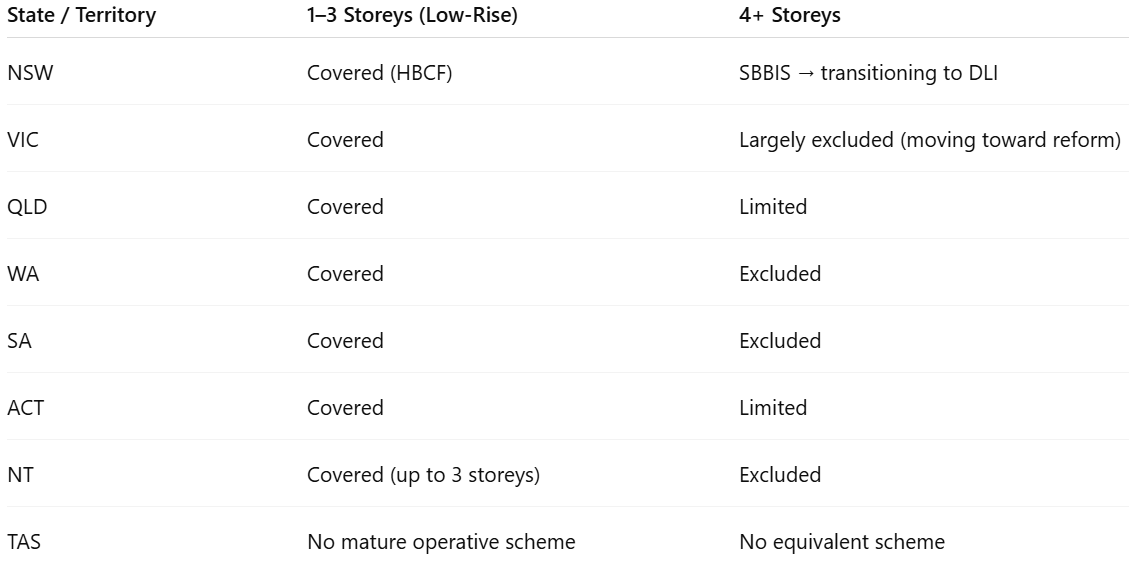
Across Australia, there’s a pattern I’ve seen repeatedly:
- Low-rise residential (1–3 storeys) tends to have structured defects warranty protection
- Once you move into 4 storeys and above, that protection drops off significantly
NSW tried to plug that gap with SBBIS.
Now it’s trying to go further with DLI.
Other states are watching closely.
8. Final Thought
From where I stand — as someone who has worked across design, construction, project management and inspection —
This is not a policy shift.
It’s a risk redistribution exercise.
SBBIS made defects visible.
DLI will make risk tradable.
But neither guarantees better buildings.
And in the end, the real question is:
Are we actually improving build quality, shifting from SBBIS to DLI — or just getting better at deciding who pays for the same problems?

📎 Appendix (For Reference)
Low-Rise vs Higher-Rise Residential Building Defect Warranty - Consumer Protection Across Australia (As of 15/04/2026)

#StrataNSW #OwnersCorporation #StrataManagement
#BuildingDefects #RemedialBuilding #SBBIS
#ConstructionRisk #BuildingCompliance
#NSWConstruction #BuildingReform
#ForensicEngineering #ProjectManagement
#ConstructionIndustry #BuiltEnvironment
#DLI(Decennial Liability Insurance)