
ArticleEngineering & construction
Efflorescence vs Concrete Cancer: Causes, Connections and Repairs
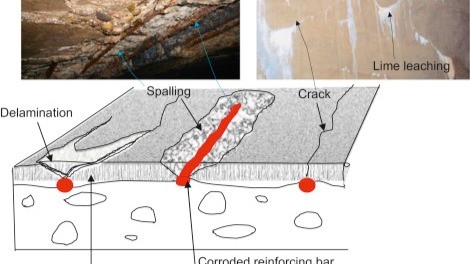
How they form, how they differ, where they connect—and how to investigate and repair them.
Efflorescence and “concrete cancer” are often confused. In my experience, even some engineers working in forensic investigations have only a partial understanding of how they form and how they are connected. This matters because an incomplete diagnosis can lead to an ineffective repair.
1. Efflorescence
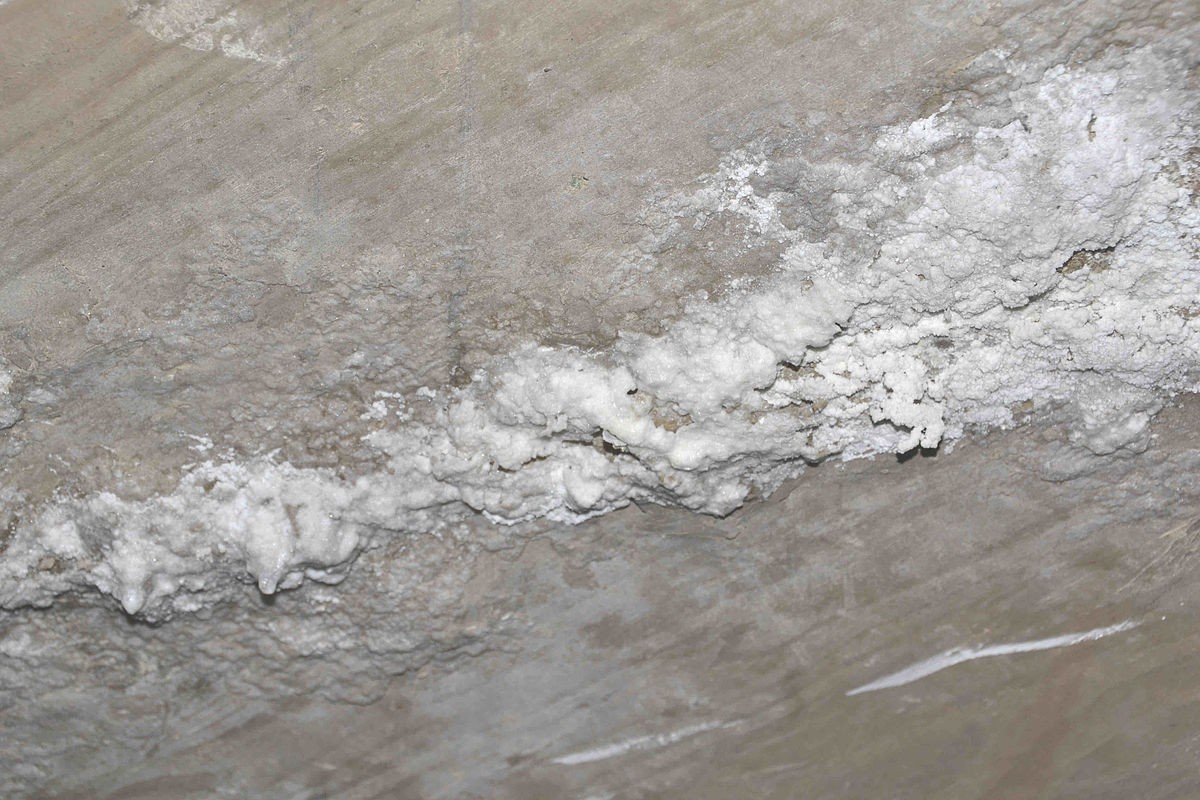
Efflorescence forms when water dissolves salts, carries them through a porous material and leaves crystals as it evaporates. On concrete, a related process is lime leaching: water dissolves calcium hydroxide from the cement paste and transports it towards an exposed surface.
There, reaction with carbon dioxide can produce a white calcium carbonate crust, sometimes forming small stalactites beneath slabs. The representative reaction is:
Ca(OH)₂ + CO₂ → CaCO₃ + H₂O
Not all white deposits are calcium carbonate, and appearance alone cannot identify their chemistry. Many surface deposits are mainly cosmetic. Repeated deposits along a leaking crack or joint, however, deserve investigation of the water source and its pathway. [1]
2. Concrete Cancer
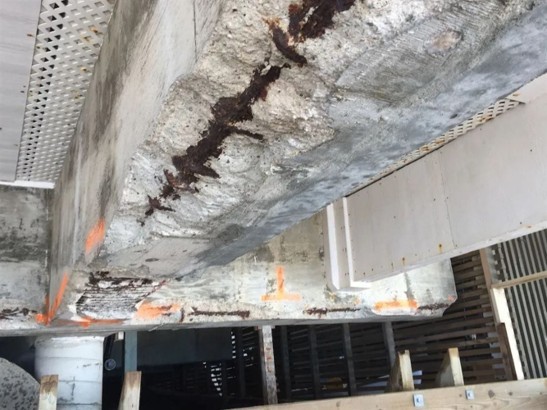
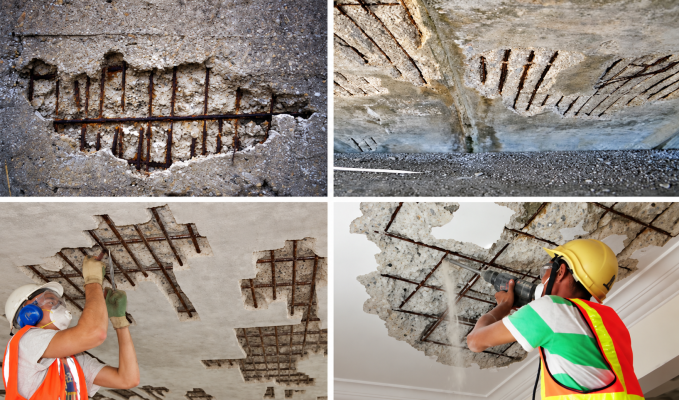
“Concrete cancer” is an informal term, commonly used for deterioration caused by corroding reinforcement. Concrete’s high alkalinity normally protects embedded steel through a thin passive film.
Two common mechanisms can undermine that protection: carbonation lowers alkalinity when carbon dioxide penetrates the concrete; chlorides can cause local breakdown of the film even while the surrounding concrete remains alkaline. With moisture and oxygen available, active corrosion can develop. [2]
One simplified overall reaction forming ferrous hydroxide is:
2Fe + O₂ + 2H₂O → 2Fe(OH)₂
Further oxidation can be represented by:
4Fe(OH)₂ + O₂ → 4FeO(OH) + 2H₂O
These balanced equations illustrate possible stages, not one universal sequence. Rust contains several iron oxides and oxyhydroxides; it has no single final formula.
Corrosion products can occupy substantially more volume than the iron consumed. Their accumulation can crack the cover, separate layers of concrete and cause pieces to fall away. Steel section loss and weakened bond may also impair structural performance. Not every spall, however, is caused by corrosion. [2]
3. Connections and Differences
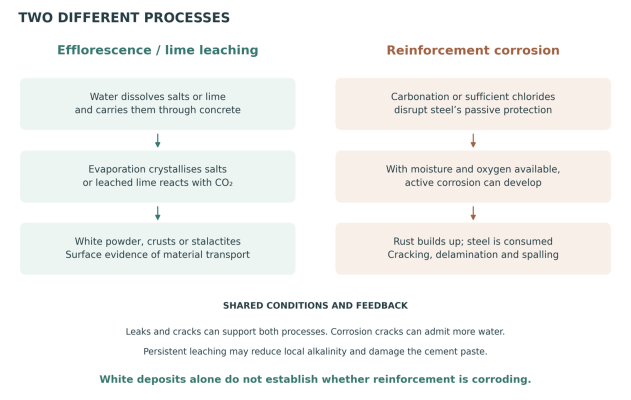
Efflorescence does not simply “turn into” concrete cancer. The connection lies mainly in water movement and the condition of the concrete. Leaks, connected pores and cracks can support both processes, while corrosion-induced cracking can open further routes for water and contaminants.
Persistent leaching can itself remove constituents of the cement paste, reduce local alkalinity and contribute to deterioration. That is different from assuming that every white stain signals damage at the reinforcement.
The calcium hydroxide reaction above also helps explain carbonation. Location matters: lime leaching carries dissolved material out to form a deposit; carbonation within the cover consumes alkalinity in place. A surface crust does not tell us how far carbonation has reached or whether the steel has lost its protection. [1, 2]
White deposits alone do not establish whether reinforcement is corroding.
4. Investigation and Repair
Depending on the findings, investigation may include mapping leaks and cracks, sounding for delamination, checking cover, testing carbonation depth and chloride content, and examining steel condition. Half-cell potential mapping can help assess the likelihood of active corrosion; it does not directly measure corrosion rate, steel loss or remaining capacity. [3]
For surface deposits, address persistent leakage and select cleaning to suit the deposit and substrate. Loose deposits may respond to dry brushing. Acid cleaning requires care: acids can attack cement paste, and hydrochloric acid introduces chlorides. Vinegar is not automatically harmless. [4a, 4b]
For corrosion damage, repairs may require removal of unsound or contaminated concrete, preparation of reinforcement, assessment of section loss and anchorage, and properly specified repair mortar with adequate curing. Widespread contamination can require a broader corrosion-control strategy: local patches alone may leave corrosion developing around their edges. [5]
Waterproofing, drainage and joint repairs must suit the actual exposure. A water-repellent treatment is not a substitute for a system designed to resist water under pressure. [6] Loose overhead concrete also needs prompt measures to protect people below.
Where steel loss is significant, the repair must also restore the required strength and anchorage; replacing the concrete cover alone is insufficient.
Efflorescence records the movement and deposition of dissolved material. “Concrete cancer” involves corrosion of reinforcement and damage to the surrounding concrete. They can share the same water pathways, but one does not prove the other. In my forensic practice, I look for evidence of both the moisture pathway and the steel’s condition. Removing white deposits does not stop a leak; patching damaged concrete does not necessarily stop corrosion. The repair must address the mechanism actually operating in the structure.
Sources and image credits:
1. The Concrete Society — Lime leaching
2. FHWA — Corrosion mechanisms in reinforced concrete
3. FHWA — Half-cell potential testing and its limitations
4a. The Concrete Society — Removing efflorescence
4b. The Concrete Society — Acids and concrete
5. ACI RAP-8 — Installation of embedded galvanic anodes
6. Sika — Example of hydrophobic treatment limitations
Cover and Figures 1–2 — Retained from Scott Chen’s original article
Author: Scott CHEN
North Star Design & Build