
ArticleEngineering & construction
AS 2870 Under Review: Lessons from UK, US and Chinese Foundation Design Frameworks
Introduction
In Australia, AS 2870:2011, Residential slabs and footings, is an important framework for residential foundation design. It supports economical, repeatable solutions for appropriate sites and buildings, but its use must remain connected to the actual ground conditions and structural requirements. A standard detail can be efficient and technically sound; it can also become an unsafe shortcut when applied outside its assumptions.
This article compares the Australian approach with selected UK, US and Chinese foundation frameworks. The purpose is to identify useful lessons and areas for improvement, not to rank entire countries from weakest to strongest. These documents have different scopes, regulatory roles and companion standards. Comparing AS 2870 alone with a whole overseas geotechnical and structural system would create a misleading result.
My central concern remains the gap that can develop between a technically defensible design process and routine residential delivery. We should demand evidence that the chosen method fits the site, that the relevant movement mechanisms are addressed, and that construction matches the design. This is a stronger basis for criticism and reform than saying AS 2870 contains no engineering analysis or settlement-related provisions.
✅Standards Compared
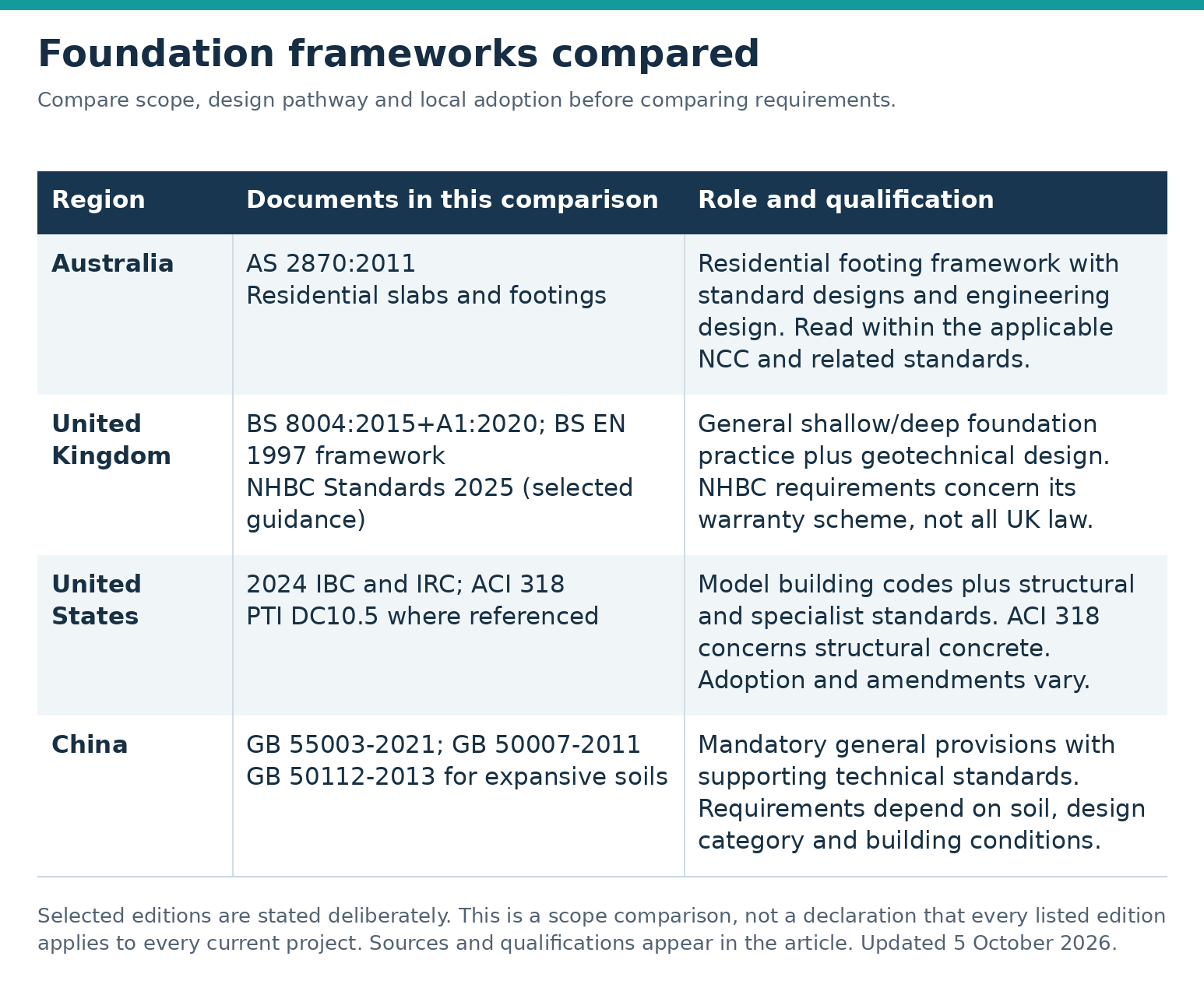
Australia: AS 2870 is a residential footing standard, not the complete Australian foundation-design and regulatory system. It includes standard-design and engineering-design pathways and must be read with the applicable NCC requirements, referenced documents and other standards relevant to the project. Its 2011 title does not include the former “Construction” subtitle used in the original table.
United Kingdom: BS 8004:2015+A1:2020 covers a broader range of shallow and deep foundations and works with the BS EN 1997 geotechnical framework. NHBC guidance adds relevant residential warranty requirements, including guidance on building near trees. NHBC requirements should not be described as statutory rules applying to every UK building. The table names the 2025 NHBC edition used for this comparison; the edition applying to a particular project must be checked.
United States: The 2024 IBC and IRC are model codes whose adoption and amendments vary by jurisdiction. ACI 318 addresses structural concrete, including concrete foundation members; it is not a standalone substitute for site investigation or geotechnical assessment. Expansive-soil provisions and referenced specialist documents, including PTI requirements where applicable, form part of the wider system. ACI has published its 2025 edition, but that does not automatically make it the adopted edition in every jurisdiction.
China: A meaningful comparison includes the mandatory general framework in GB 55003-2021, the foundation-design provisions in GB 50007-2011 and the expansive-soil provisions in GB 50112-2013. GB 55003 took effect on 1 January 2022 and superseded specified earlier mandatory clauses; it did not simply abolish every supporting technical standard. The applicable hierarchy and any conflicting provisions must be checked.
✅International Standard Comparison
The original comparison presented broad claims such as mandatory detailed investigation for every overseas project, no project-specific adjustment under AS 2870, and universally superior settlement control abroad. Those claims were too absolute. The revised table instead separates what AS 2870 actually provides from the questions that any competent foundation design should answer.
Two examples illustrate why scope matters. A UK trench-foundation depth is not directly equivalent to an Australian raft-rib depth, because the systems resist ground movement differently. Similarly, the US expansive-soil provisions include engineered slab-on-ground solutions; they do not impose a universal piling requirement. China’s expansive-soil provisions also allow different foundation types according to conditions and severity.
Meaningful comparisons therefore need the same building form, loads, soil profile, movement demand, performance criteria and construction controls. More elaborate calculations cannot compensate for an incorrect ground model, and a simplified method is not intrinsically unsound when its assumptions and limits are satisfied. The issue is whether the evidence and method are appropriate to the risk.

✅Professional Summary
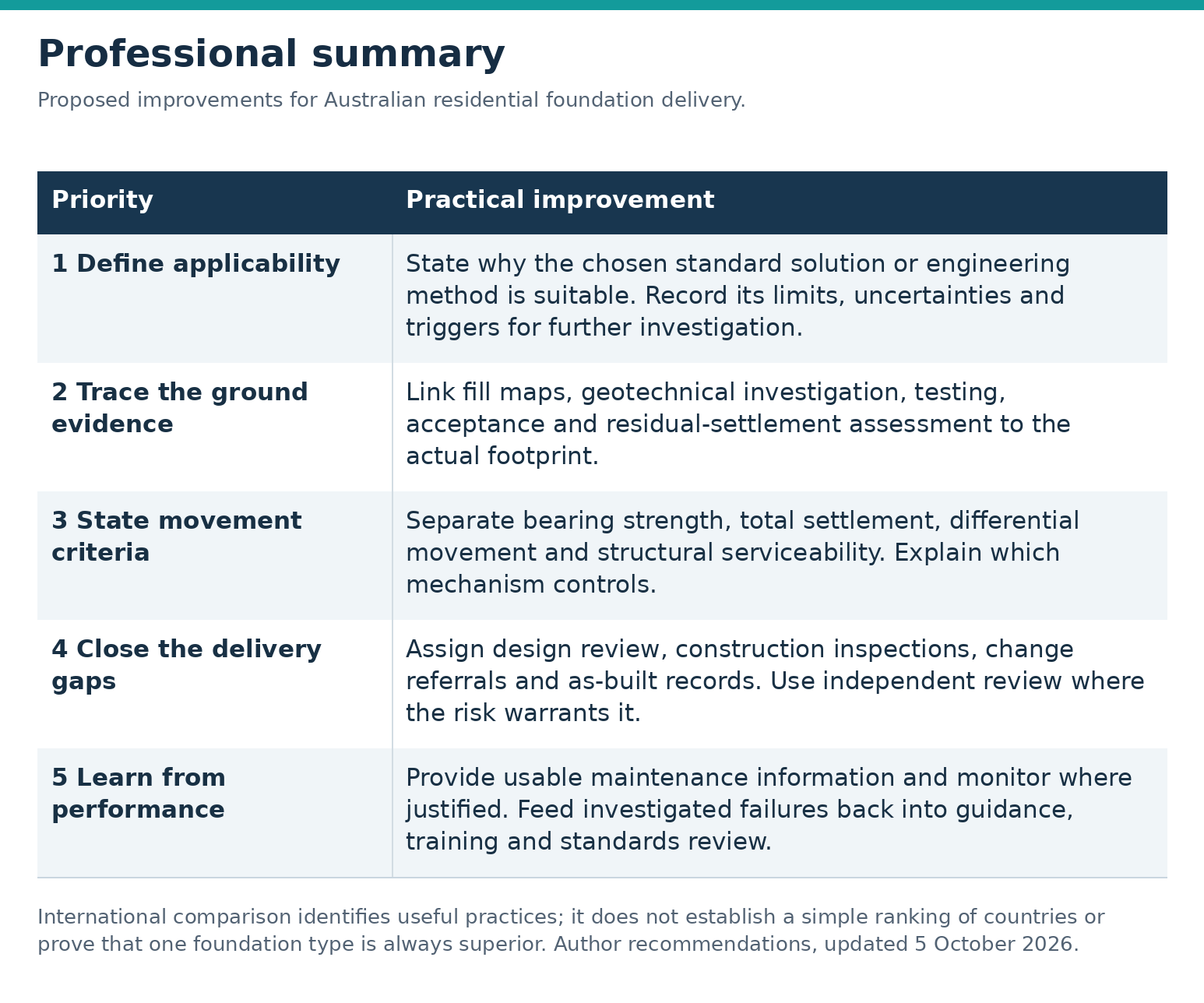
International practice offers useful examples of explicit geotechnical design, foundation selection, construction verification and reporting. It does not establish that every foreign project receives better engineering, or that Australian residential slabs are inherently unsuitable for reactive clay. My proposed improvements focus on making the design basis visible, checking it against the site and preserving responsibility through construction.
The priorities below are professional recommendations. Some overlap with existing obligations; others would benefit from clearer guidance, stronger implementation or further standards review. Their legal status depends on the project and jurisdiction and should not be inferred from this summary table.
✅ Professional Critique of AS 2870
While AS 2870 remains a useful residential engineering framework, its application and supporting delivery processes deserve critical examination. I would retain five areas for improvement, expressed more precisely than in the original version:
- Simplification must remain within its validated limits. Empirical methods and standard details are legitimate engineering tools. The danger arises when a site-class label is treated as a complete description of a complex soil–structure problem. Section 3 designs have stated limits, and Class E and P sites are outside that standard-design pathway. Section 4 provides engineering principles, including consideration of soil–structure interaction. The criticism should therefore be directed at inappropriate extrapolation, inadequate inputs and weak documentation of applicability. I support clearer decision points that require the designer to explain why the selected method is suitable and when further investigation or analysis is necessary.
- Site-specific information must reach the actual design. It is incorrect to say AS 2870 permits designers to disregard soil properties, building loads or site conditions. The practical concern is whether reports are sufficiently representative and whether their qualifications survive the handover into the structural drawings. Fill depth, cut-and-fill transitions, compressible strata, vegetation, drainage changes and nearby works can matter more than the headline class. A report based on limited exploration should state those limits. I favour a traceable design-basis record linking the investigation, final building footprint, load assumptions and foundation selection, with unresolved issues identified before construction.
- Moisture and climate assumptions need scrutiny. AS 2870 is not silent about moisture-driven movement or abnormal conditions. The more useful question is whether the adopted moisture and ground-movement model remains appropriate for the site’s history and foreseeable conditions. Prolonged drying, subsequent wetting, vegetation changes, leaks and altered surface or groundwater behaviour may challenge a routine assumption. Rather than claim that every extreme event is already quantified adequately, or that none is considered at all, I support targeted review of climate-related guidance and investigation triggers. Designers should explain their assumptions, relevant uncertainties and the measures relied on to manage them.
- State the relevant movement criteria explicitly. The original statement that AS 2870 has no systematic settlement-control mechanisms was too broad. Section 4 includes differential footing-deflection limits and an engineering framework for reactive-soil response. However, a differential-deflection limit is not a universal allowable total settlement for all buildings and mechanisms. Consolidation of deep fill or soft layers, wetting collapse, local loss of support and clay heave may require distinct assessment. A credible design should identify which movement controls, how it is estimated, what the structure can tolerate and why the chosen criteria are appropriate. Ultimate bearing resistance alone does not establish acceptable serviceability.
- Close the gaps between design, construction and oversight. AS 2870 does not itself constitute the entire approval, inspection and professional-responsibility system. Claims that it universally permits minimal records or removes the need for verification confuse technical provisions with their administration. Nevertheless, fragmented responsibility is a real risk worth addressing: who confirms the founding conditions, reviews earthworks information, inspects critical work and approves changes? For higher-risk sites, I advocate proportionate independent review and clear release points, backed by construction and as-built records. A certificate should record the outcome of that process rather than replace it.
✅Final Professional Conclusion
AS 2870 should be judged on both its actual provisions and how reliably they are implemented. It is not merely a catalogue of economical slab details, and it cannot be expected to replace every other geotechnical, structural and regulatory requirement. Its standard solutions remain useful when their conditions are satisfied.
✅ A Word of Caution
If we rely on standard details without checking their applicability, we risk carrying an untested assumption from the soil report all the way into the completed home. That is the warning I want this article to preserve. The answer is competent engineering, sufficient evidence and accountable execution throughout the project.
Author: Scott Chen

Technical References and Revision Note
Updated 5 October 2026. The three comparison tables have been replaced. This revision corrects the title and scope of AS 2870, acknowledges its engineering-design and differential-deflection provisions, distinguishes model codes from local adoption and warranty guidance, and recasts the five criticisms as evidence-based areas for improvement. The listed editions identify the comparison sources rather than asserting their universal current legal application.
- AS 2870:2011, Residential slabs and footings — especially Sections 2–4 and the limits of the standard-design pathway.
- BSI: BS 8004:2015+A1:2020 — scope and relationship to BS EN 1997.
- NHBC Standards 2025 — selected residential warranty guidance, particularly Chapter 4.2.
- 2024 IRC, Chapter 4 and 2024 IBC, Chapter 18 — expansive-soil design within the model-code framework.
- ACI CODE-318-25 — structural-concrete scope and publication information; project adoption must be checked separately.
- GB 55003-2021, General code for foundation engineering of buildings and municipal projects — mandatory general framework, read with applicable supporting standards including GB 50007-2011.
- GB 50112-2013, Section 5.7 — selection and design of foundations on expansive soil.
North Star Design & Build
CPEng, MIEAust, NER | Licensed Builder | PMP | MCIOB | MAIPM